
BluSkyi Features

How BluSkyi pairs advanced technology with human editorial governance to deliver practice-focused Insight Articles and automated CPD logging

A Personalised Weekly Briefing of Insight Articles

There are tens of thousands of new research papers published weekly in your sector. BluSkyi uses your preferences and a rigorous quality control process to distil this down to a personalised, manageable briefing.

You'll receive 30 Insight Articles every week, each an accurate ~1,000-word summary of a full research paper. Targeted at professionals, Insight Articles lead with practical implications, with technical detail in support.

Rigorous by Design

We pair advanced AI with disciplined human editorial oversight to deliver the research that matters at pace and breadth, and with the accountability that AI alone cannot provide.

BluSkyi reads across tens of thousands of new papers every week, identifies what is most relevant to professional practice, and translates it into clear, decision-ready Insight Articles. Editorial governance ensures that what reaches our subscribers is properly sourced, accurate, and worth your time. Every Insight Article passes through a meticulous six-stage production process, with named human accountability at key decision points.

  1. Scanning

    Every day, BluSkyi scans OpenAlex, the world's most comprehensive open-access index of scholarly research, for both peer-reviewed and pre-print papers. Only work that clears our quality benchmarks – including indexing in Scopus, Elsevier's expert-curated standard – is allowed through, so every source meets a consistent standard before it goes any further. The result is breadth of coverage with rigour of source.

  2. Filtering

    We apply a proprietary modification of the Leiden Ranking system to surface the best new research. Our systems also continuously monitor the academic landscape to identify previously published papers that are rapidly gaining momentum.

  3. Insight Article Creation

    BluSkyi drafts each Insight Article under strict provenance rules: every factual claim must be drawn directly from the original paper. No external sources are introduced, no assumptions made, nothing inferred. Our editorial methodology explicitly forbids the free-form generation that causes hallucinations in general-purpose AI tools – the control behind content subscribers can trust.

  4. Provenance Check

    Alongside each draft, BluSkyi produces a structured provenance record that flags every factual claim with its source and a confidence rating. Our Managing Editor team works through these claims in a proprietary editorial dashboard – accepting or revising – and no Insight Article moves forward until every flagged item has been adjudicated. This discipline is critical in elevating AI assistance into a trustworthy publication partner.

  5. Researcher Verification

    The original research team is invited to confirm that the Insight Article accurately represents their research, and we incorporate any feedback they provide.

  6. Briefing Curation

    From the pool of completed Insight Articles, each subscriber receives an individually unique weekly briefing, shaped around the focus areas and disciplines they've chosen. It brings together new work and the research that's proving to matter. Every Insight Article in the pool has already cleared full editorial oversight, so personalisation never compromises quality.

Inside BluSkyi

A clean, intuitive interface makes staying ahead effortless.
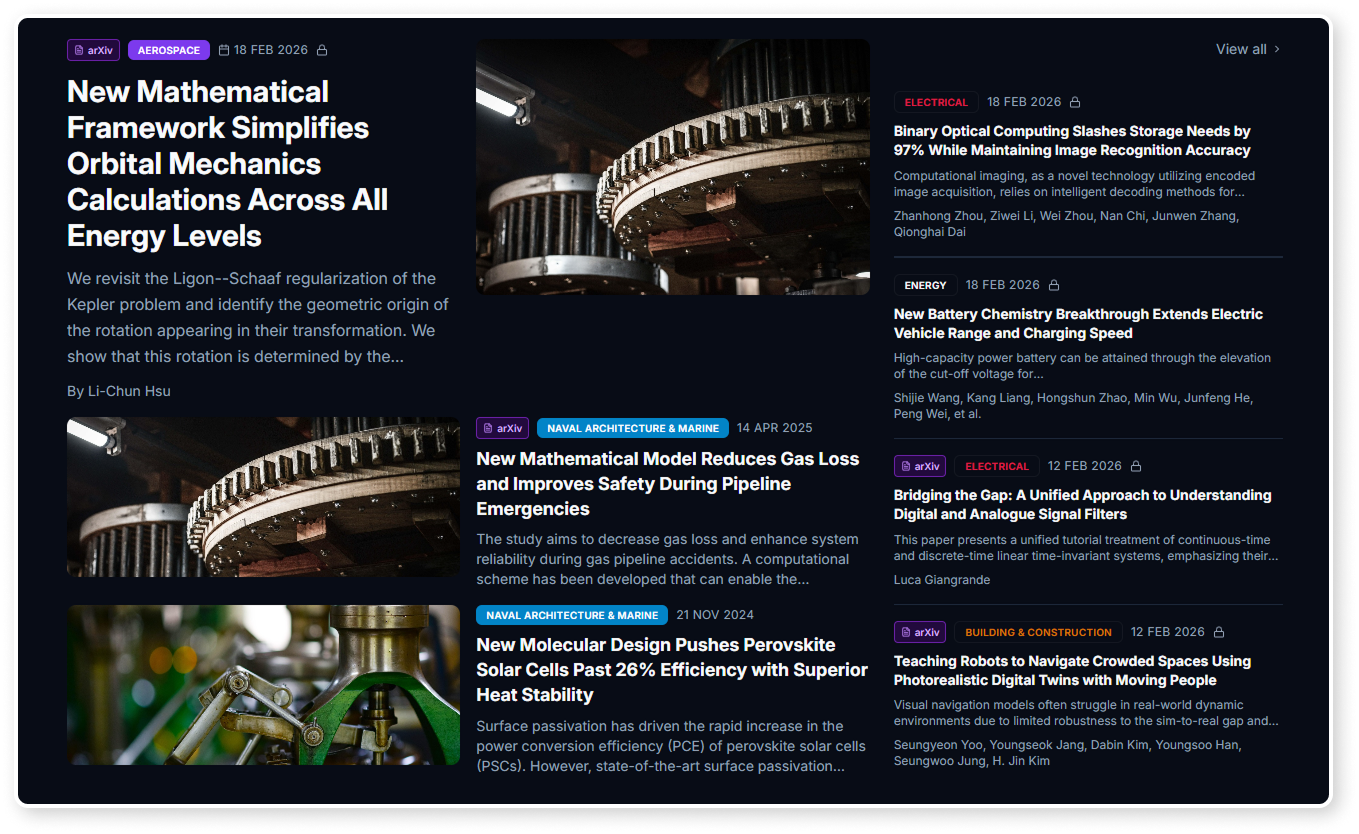
BluSkyi subscriber dashboard showing personalised weekly research briefing.

Your Subscriber Homepage

Toggle between this week's Insight Articles, last week's, or earlier briefings. Access, set up, and adjust filters; view your library of saved Insight Articles and browse those shared with you; view your subscription details; set up and monitor CPD; and edit your profile.

What Does an Insight Article Look Like?

Every Insight Article includes a headline that speaks directly to practising professionals, a plain-language summary, key findings, practical applications for your work, and a link to the source paper.

Engineering · Mechanical

Ionic Liquid Additives Lose Their Anti-Wear Edge Once Oil Temperatures Rise

Phosphonium ionic liquids are increasingly seen as candidates to replace some conventional lubricant additives. This study tempers that expectation. On steel ball-on-disc contacts at 18 °C, one candidate, [P4442][DEP], delivered the lowest wear of any additive tested. At 60 °C and 80 °C none of the three liquids protected as well as zinc dialkyldithiophosphate (ZDDP). Nanoscale tests point to the reason: their protective films grow slowly and appear to need fresh wear to start.

Engineering · Computer Science & Software

Robo-Taxi Fleet Controller Nears Oracle Profit and Adapts to New Cities in 10 Episodes

Robo-taxi services only pay off if idle vehicles are in the right place before demand appears. This work shows that a hybrid controller, with optimisation handling the hard constraints and a graph neural network deciding where vehicles should be, earns within 1.6–2.3% of a perfect-foresight oracle in simulation, transfers across cities, network layouts and simulator fidelities with modest losses, and adapts to a new city with 10 training episodes rather than 10,000.

Engineering · Industrial & Manufacturing

A 155-Fold Faster Model Pulls Die Casting Vent Design Out of Trial and Error

The vents that let air escape a high-pressure die casting are still largely designed by prototype, because a single full 3D airflow simulation can take weeks. A coupled 0D–1D–3D model with adaptive time-stepping now runs nearly 155 times faster, finishing in hours on a standard PC while tracking pressures measured on an industrial test rig. The caveat is that its five fitted constants are proven only within a narrow envelope of vent sizes and tank volumes.

Engineering · Nuclear

Deep Learning Surrogates Evaluate Loss-of-Coolant Scenarios 10,000 Times Faster Than Code

Deep learning surrogates trained on 1,020 stored thermal-hydraulic simulations of a large-break loss-of-coolant accident predict peak cladding temperature to within about 10 K in blowdown and 22 K in reflood, and evaluate roughly 10,000 times faster than the system code. They reproduce the code's sensitivity rankings, and their 95/95 upper bounds converge with the code's, though the authors caution that the surrogates tend to under-predict the high temperatures that set that limit. Licensing-grade confidence has not been reached.

Engineering · Electrical

Listening Model Cuts Fault-Detection Errors by More Than Half on Noisy Pump Audio

Acoustic monitoring promises non-contact fault detection for pumps, motors and power plant, but single-network models struggle with noise and scarce fault examples. DBAN-Net runs a convolutional branch and a recurrent branch in parallel and lets a lightweight attention gate weight them. On a public pump dataset it cut classification errors from 4.2% to 1.74% against the best baseline, and led at every training-data scale tested. Validation beyond pumps is still to come.

Engineering · Chemical

Adding Tropoelastin Gives Silk Hydrogels Micropores and Curbs Their Stiffening

Silk hydrogels suit light-based fabrication but carry two defects: pores too small for cells, and steady stiffening after they are made. Blending silk with tropoelastin in equal parts and curing with visible light addresses both in a single step, with no chemical modification. Pores grow roughly fivefold, four-week stiffening drops from about 12.9-fold to no more than 2.3-fold, and cells colonise implants in mice. Tissue sealing and printing remain proof-of-concept demonstrations.

Engineering · Earth Sciences & Petroleum

Off-the-Shelf Machine Learning Predicts Deepwater Standpipe Pressure Without Custom Code

Machine learning for drilling hydraulics has largely stayed with data specialists, because the strongest hybrid models demand bespoke code. This study shows that four standard tree-ensemble models, run inside a no-code platform, can predict standpipe pressure across four deepwater gas wells with test R² between 0.968 and 0.994. The workflow is the real contribution. The accuracy still needs tougher validation, and every new field will need its own retraining.

Engineering · Biomedical

Implant Scaffolds Should Dissolve on the Body's Healing Schedule, Not the Chemist's

A degradable scaffold succeeds only if it disappears at the pace new tissue arrives. This review collates published degradation data for PLA, PVA, PCL and PU and lines them up against tissue healing times: PVA suits fast-healing skin and cornea, while PLA, PCL and PU fit slower bone, cartilage, ligament, neural and vascular repair. The rule is useful. The underlying numbers, drawn from mismatched test conditions and extrapolated, are not yet design data.

Engineering · Environmental

Pilot Links Membrane CO2 Capture to Microbes That Make Grid-Quality Methane

The chain works, with conditions attached. A two-stage polyimide membrane unit reached 94.3% CO2 purity at 71% recovery, but only from a 27% CO2 feed; at 15% it managed 70.4%. Downstream, trickle-bed reactors fed that CO2 with electrolytic hydrogen held methane above 95% at a two-hour gas retention time. The authors estimate pilot capture cost at 150–200 €/t CO2, with compression electricity the main driver. Richer CO2 sources suit the membrane stage best.

Engineering · Energy

Measuring Deflection, Not Torque, Sets Solid-State Battery Pressure to Within 3%

Sulfide-based solid-state batteries need tens of megapascals of stack pressure, yet a common approach is to tighten bolts and neglect the fixture's elastic relaxation. This study shows why that fails at scale and offers a cheap fix: compensate for the fixture's own elastic deflection and measure it directly. On 96 cm² pouch-cell fixtures the method held pressure error to 2.16% across 10–30 MPa, giving large-format cell research a documented, reproducible pressure-setting method.

Engineering · Materials

Machine Learning Puts Atom-Scale Defect Fabrication in 2D Materials on Autopilot

Engineering materials atom by atom has been a hand-operated craft. This team has turned it into a closed loop: machine learning labels each atom in a live microscope image, a rules engine picks which sulfur atoms to remove, and a programmable controller fires the beam. The system seeds, places and grows metallic nanowire edges in monolayer MoS2 unaided; its directional-growth strategy succeeded in 65% of 42 runs, using models trained on a few dozen hand-labelled examples.

Engineering · Aerospace

Four Safety Gates Stand Between a Civil Turboprop and the Forward Air Control Role

A light civil turboprop can do much of what an airborne forward air controller needs: it climbs hard, loiters for hours and has well-damped dynamics that forgive a pilot looking outside the cockpit. But a single exit door, a sidestick that fouls the cockpit wall, weak pitch-force cues and no secure radio are hard gates, not trade-offs. For buyers of commercial derivative aircraft, the lesson is that civil airworthiness says little about military suitability until someone flies the mission.

Engineering · Automotive

Aviation's Tool Qualification Rules Score Highest for Transfer to Autonomous Driving

Autonomous driving is pushing vehicle software into territory where automotive safety processes look thin beside aviation's. Walking both industries along the V-model, the authors identify ten transferable practices and score nine for feasibility. DO-330-style tool qualification scores 9.42 out of 10, far ahead of the rest; requirements practices follow. Making authority involvement mandatory is the only proposal to score below the neutral mark of 5. The weightings come from one manufacturer, so the ranking is indicative.

Engineering · Civil

Three-Path Load Sharing Makes a Hybrid Bridge Joint Simpler to Design

Hybrid girder bridges that splice a steel-concrete composite segment into a prestressed concrete span address the pavement and fatigue problems of steel box decks, but the joint between the two has lacked a clear design basis. This modelling study shows axial force split almost evenly between bearing plate and shear connectors, identifies points of diminishing return for plate thickness and joint length, and isolates a single connector row that governs shear design.

Engineering · Marine

Real Ocean Winds Undercut the Design Assumptions Behind Wind-Assisted Ship Propulsion

Wind-assisted propulsion is designed and tested against idealised wind. Two lidars on a chemical tanker show the real apparent wind is reshaped by hull, superstructure and the sails themselves, rarely follows the standard 1/7 or 1/9 power-law profiles, and carries strong fluctuations far more often than Gaussian models allow. For sail suppliers, ship operators and rule-makers, the inflow assumptions used in design, simulation and operation need revisiting, and the authors have released reference time series to do it.

BluSkyi's Guiding Philosophy

Our use of AI is governed by five clear principles, which ensure that our editorial process is enhanced by technology, never replaced by it.

Respect for IP

We strictly honour intellectual property rights, generating Insight Articles exclusively from openly licensed research that explicitly permits reuse.

No Unsupervised AI Output

AI may only state what the source paper supports. Claims that cannot be evidenced are removed, not hedged with invented qualifiers.

Named-Human Accountability

A human editor is responsible for every published Insight Article. AI assists; humans decide.

AI Use Transparency

We are clear where AI sits in our workflow – and where it does not.

Community Engagement

Meaningfully bridging academia and industry is core to our mission; the researchers behind each paper are invited to verify how their findings are represented.

Stylised illustration of an AI governance system – a glowing wireframe iris connected to circuit traces.

Experience BluSkyi working for you

Get full access to BluSkyi – no card required, no commitment.